
www.ptreview.co.uk
05
'26
Written on Modified on
Renesas unveils RZ/T2N processor for industrial automation & robotics
The single-chip MPU integrates four-axis motor control, industrial Ethernet and Linux processing, reducing hardware complexity and supporting compact equipment designs.
www.renesas.com
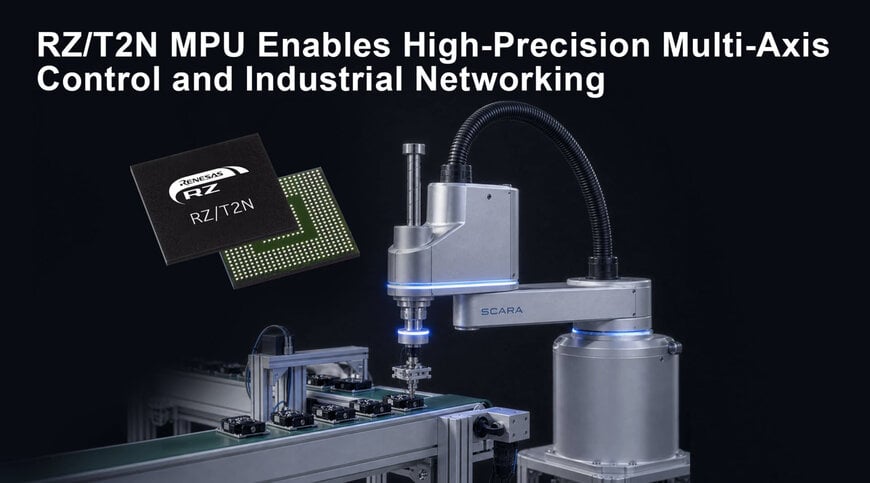
Designing compact industrial robots and multi-axis servo systems requires balancing high-throughput supervisory networking with microsecond-level deterministic motor commutation. To eliminate the high component count, board congestion, and inter-processor latency typical of multi-chip motion architectures, Renesas Electronics introduced the RZ/T2N 64-bit microprocessor (MPU). The device integrates high-precision real-time motor control, fieldbus connectivity, and Linux application processing into a single integrated circuit, targeting industrial machinery such as Selective Compliance Assembly Robot Arm (SCARA) systems, delta pick-and-place robots, and programmable logic controllers (PLCs).
Heterogeneous Multicore Architecture and Memory Hierarchy
Traditional industrial automation controllers partition workloads across separate physical chips: an application processor runs high-level human-machine interfaces (HMIs) or supervisory tasks, a dedicated digital signal processor or microcontroller handles current and velocity loops, and an external ASIC manages industrial Ethernet communication. This distributed layout introduces PCB routing bottlenecks and inter-IC communication delays across SPI or PCIe buses.
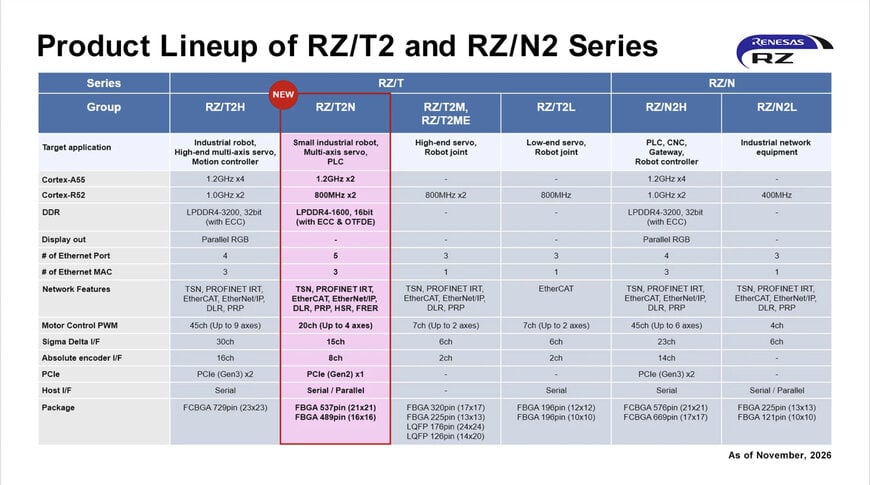
The RZ/T2N replaces this multi-device scheme by pairing application and deterministic compute cores on one die. High-level workloads run on two Arm Cortex-A55 cores clocked up to 1.2 GHz, providing the processing power needed for Linux execution, edge computing, and supervisory tasks. Deterministic control loops execute on two Arm Cortex-R52 cores operating at up to 800 MHz.
To prevent execution-time jitter during high-speed pulse-width modulation (PWM) calculations, each Cortex-R52 core is paired with 576 KB of tightly coupled memory (TCM) equipped with Error-Correcting Code (ECC). The core accesses TCM without going through shared system buses, enabling deterministic, zero-wait-state instruction and data access. System-wide reliability is reinforced by extending ECC protection across CPU caches, internal SRAM, and external memory interfaces. The external memory subsystem supports 16-bit LPDDR4-1600 SDRAM featuring on-the-fly encryption and decryption to protect runtime binaries.
Four-Axis Motion Peripherals and Multi-Protocol Encoder Interfaces
Coordinated multi-axis motion in SCARA and delta robotics demands tightly synchronized velocity and position loops across multiple mechanical joints. The RZ/T2N incorporates peripheral hardware capable of driving up to four independent motor axes directly from the MPU.
Each axis includes two dedicated encoder interface channels, allowing machines to monitor dual feedback loops, such as motor-side velocity and load-side absolute position. The interface subsystem supports legacy and next-generation absolute encoder communication standards:
- Tamagawa T-Format, HIPERFACE DSL, and A-format
- EnDat 2.2 and EnDat 3
- BiSS C and BiSS Line
Hardware-level decoding of these protocols offloads serial parsing from the central processing units, maintaining phase margin during dynamic robotic maneuvers.
Industrial Ethernet Integration and Hardware Redundancy
For distributed factory environments, the MPU features an integrated Ethernet subsystem designed to operate as either a master network controller or a subordinate field device. The communication block includes three Gigabit Ethernet MACs (GMACs), an integrated Ethernet switch, and a dedicated EtherCAT SubDevice Controller (ESC).
This on-chip architecture supports fieldbus and real-time networking protocols without external PHY controllers or communication coprocessors, including:
- EtherCAT
- PROFINET RT and IRT
- EtherNet/IP
- Time-Sensitive Networking (TSN) mechanisms
To ensure operational uptime in critical manufacturing networks, the subsystem incorporates hardware-accelerated redundancy protocols: High-availability Seamless Redundancy (HSR), Parallel Redundancy Protocol (PRP), and Frame Replication and Elimination for Reliability (FRER) under IEEE 802.1CB. Security implementations rely on Arm TrustZone, secure boot authentication, encrypted firmware update pipelines, and a dedicated cryptographic hardware engine.
Hari Pendurty, Vice President of the EP Edge AI and Application Processors Business Division at Renesas, noted that industrial equipment designers must balance functionality and processing performance against PCB footprint and bill-of-materials cost. Pendurty explained that consolidating motion control, fieldbus switching, and application execution onto a single chip addresses these trade-offs while offering design flexibility for scalable automation platforms.
Software Ecosystem and Trade Show Demonstration
Software development utilizes the unified Renesas Flexible Software Package (FSP) and a shared Linux distribution compatible with the wider RZ/T2 and RZ/N2 series. Certified sample applications cover industrial fieldbus stacks, encoder communication drivers, and multi-axis motor control reference boards. Certified functional safety software packages compliant with IEC 61508 standards are scheduled for deployment during the second half of 2027.
Renesas plans to demonstrate the RZ/T2N MPU running synchronized multi-axis robotics live at electronica 2026, taking place November 10–13 in Munich, Germany, at Hall C5, Stand 479.
Additional Context:
This section details technical specifications and competitive benchmarking not included in the original product announcement.
The RZ/T2N expands the Renesas motor control lineup by bridging the performance gap between real-time microcontrollers and high-end industrial MPUs. Earlier devices in the family, such as the RZ/T2M and RZ/T2L, rely purely on Cortex-R52 real-time cores (running at up to 800 MHz) paired with on-chip SRAM to execute motion algorithms and fieldbus stacks. While effective for standalone servo amplifiers, legacy RZ/T2 chips lack 64-bit application processors capable of hosting general-purpose operating systems, forcing automation builders to place an external application MPU on the board to run Human-Machine Interface (HMI) graphics, OPC UA servers, or edge machine-learning diagnostics.
At the upper tier of the industrial motion market, the RZ/T2N sits alongside higher-axis processors such as the Renesas RZ/T2H, which integrates four Cortex-A55 cores and two Cortex-R52 cores to govern up to nine motor axes simultaneously. In the broader competitive embedded landscape, the RZ/T2N competes directly against heterogeneous industrial system-on-chip architectures such as Texas Instruments' AM64x Sitara family (dual Cortex-A53 up to 1.0 GHz paired with dual Cortex-R5F cores and PRU-ICSS subsystems) and STMicroelectronics' STM32MP1/MP2 series.
While the TI Sitara AM64x relies on programmable real-time units (PRU-ICSS) to generate specialized industrial Ethernet and encoder protocols through firmware emulation, the RZ/T2N integrates dedicated fixed-function hardware blocks for digital encoder interfaces (such as EnDat 3 and BiSS Line) and an EtherCAT SubDevice Controller. This hardware-centric peripheral integration eliminates core-cycle overhead on the real-time processing units, dedicating the Cortex-R52 computational bandwidth to motor vector control and trajectory generation.
Edited by Natania Lyngdoh, Induportals editor, with AI assistance.
www.renesas.com
