
www.ptreview.co.uk
13
'26
Written on Modified on
Melexis Launches Tactile Fingertip Module Bringing True 3D Force Sensing
Combining Tactaxis magnetic technology with complete mechatronic integration, the MLX90901 module helps humanoid robot developers simplify hardware prototyping, improve grasping dexterity, and accelerate physical AI.
www.melexis.com
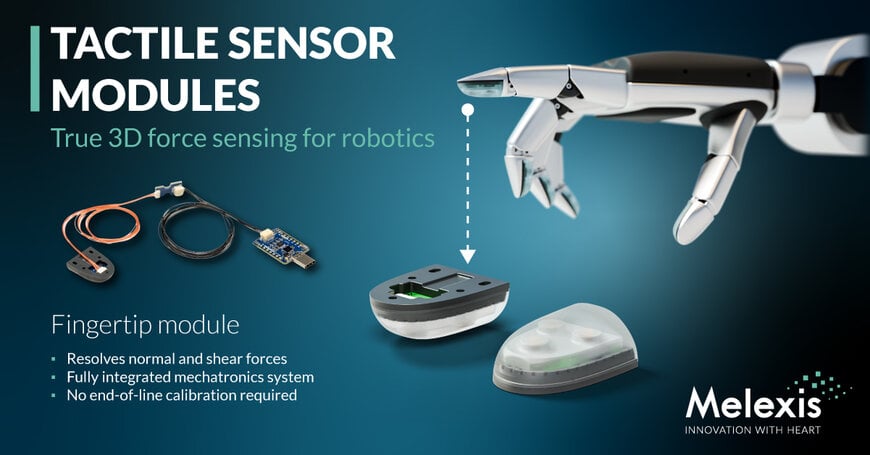
Advancements in machine learning allow autonomous systems to plan complex tasks, yet physical execution remains constrained by limited sensory feedback at the point of contact. Standard industrial grippers typically lack tactile sensors or rely on single-axis force measurements, which detect pressure perpendicular to a surface but fail to register lateral slippage. While multi-axis tactile sensors exist in academic laboratories, they often depend on custom elastomer formulations, complex wiring, and manual calibration that prevent high-volume manufacturing.
To manipulate irregular or fragile objects without dropping or crushing them, robotic control loops require real-time data on both the magnitude and direction of contact forces. Resolving forces across three orthogonal axes allows a robotic hand controller to detect incipient slip and adjust grip strength dynamically.
Operating Principle and Mechatronic Integration
The MLX90901 resolves three-dimensional contact forces by combining Melexis’ magnetic Tactaxis sensing technology with a complete mechanical and electronic assembly. In a magnetic tactile sensor, external mechanical loads deform a compliant elastomer layer embedded with a permanent magnet. A multi-axis Hall-effect magnetic sensor beneath the elastomer measures the resulting changes in the magnetic flux vector and translates those variations into normal and shear force components.
Because the performance of a magnetic tactile sensor depends heavily on the mechanical properties of the elastomer and the precise alignment of the magnet, integrating bare sensor dies presents significant engineering overhead. Melexis addresses this by packaging the sensor die, permanent magnet, compliant elastomer, structural housing, and signal-conditioning electronics into a standardized fingertip form factor. This unified architecture eliminates the need for robotic hand manufacturers to source and calibrate separate mechanical and magnetic subsystems.
Measurable Performance and System Specifications
The MLX90901 is engineered to capture subtle force variations during delicate handling while withstanding standard manipulation loads. Key performance parameters include:
- Normal force measurement range of 15 N
- Shear force measurement range of 4 N across two orthogonal axes
- Full-scale measurement accuracy of 10 percent
- Typical force resolution of 200 mN
- Digital communication via an I2C interface for direct connection to embedded hand controllers
According to Julien Ghaye, Product Line Manager at Melexis, engineering the complete mechatronic module rather than supplying a standalone sensing element allows the company to manage the interdependent material, mechanical, and electronic variables required for volume production.
Development Workflow and Prototyping Support
To support system integration, Melexis provides the DVK90901 evaluation kit alongside the fingertip module. Robotic hand manufacturers and original equipment manufacturers can use the kit to characterize the three-axis force response of the sensor, benchmark performance against specific manipulation requirements, and gather contact datasets for training closed-loop control algorithms.
The release follows four years of development since Melexis first demonstrated the biomimetic Tactaxis principle using discrete tactile pixels, or taxels. Subsequent customer trials informed the transition from individual sensor components to a standardized, production-ready fingertip module suited for humanoid robotics platforms.
Additional Context
This section details technical specifications and competitive benchmarking not included in the original product announcement.
The development of integrated three-axis tactile modules reflects a broader shift in robotics toward physical artificial intelligence, where sensorimotor data is used to train foundation models for manipulation. Historically, commercial tactile sensing has been divided between capacitive arrays, piezoresistive films, and optical-tactile sensors such as GelSight-style cameras. While optical tactile sensors offer high spatial resolution by tracking the deformation of an internal gel layer with a miniature camera, they require substantial internal volume, higher power consumption, and computationally intensive image processing.
Magnetic tactile sensors like the MLX90901 offer an alternative architecture characterized by a compact physical footprint, low power draw, and low-latency digital output over standard serial buses such as I2C. By outputting direct three-axis force vectors rather than raw image frames, magnetic modules reduce the computational burden on local joint controllers. However, magnetic sensing architectures must manage external magnetic interference, a factor typically addressed through differential sensing geometries or localized magnetic shielding within the sensor package.
Edited by Evgeny Churilov, Induportals Media - Adapted by AI.
www.melexis.com
Development Workflow and Prototyping Support
To support system integration, Melexis provides the DVK90901 evaluation kit alongside the fingertip module. Robotic hand manufacturers and original equipment manufacturers can use the kit to characterize the three-axis force response of the sensor, benchmark performance against specific manipulation requirements, and gather contact datasets for training closed-loop control algorithms.
The release follows four years of development since Melexis first demonstrated the biomimetic Tactaxis principle using discrete tactile pixels, or taxels. Subsequent customer trials informed the transition from individual sensor components to a standardized, production-ready fingertip module suited for humanoid robotics platforms.
Additional Context
This section details technical specifications and competitive benchmarking not included in the original product announcement.
The development of integrated three-axis tactile modules reflects a broader shift in robotics toward physical artificial intelligence, where sensorimotor data is used to train foundation models for manipulation. Historically, commercial tactile sensing has been divided between capacitive arrays, piezoresistive films, and optical-tactile sensors such as GelSight-style cameras. While optical tactile sensors offer high spatial resolution by tracking the deformation of an internal gel layer with a miniature camera, they require substantial internal volume, higher power consumption, and computationally intensive image processing.
Magnetic tactile sensors like the MLX90901 offer an alternative architecture characterized by a compact physical footprint, low power draw, and low-latency digital output over standard serial buses such as I2C. By outputting direct three-axis force vectors rather than raw image frames, magnetic modules reduce the computational burden on local joint controllers. However, magnetic sensing architectures must manage external magnetic interference, a factor typically addressed through differential sensing geometries or localized magnetic shielding within the sensor package.
Edited by Evgeny Churilov, Induportals Media - Adapted by AI.
www.melexis.com
