
www.ptreview.co.uk
26
'26
Written on Modified on
Industrial AI and Goal-Oriented Automation Advance Autonomous Production at SPS
Siemens presented AI agents and physical AI for planning, engineering and operations at SPS 2026, alongside new drives, DC switching and cybersecurity support.
www.siemens.com
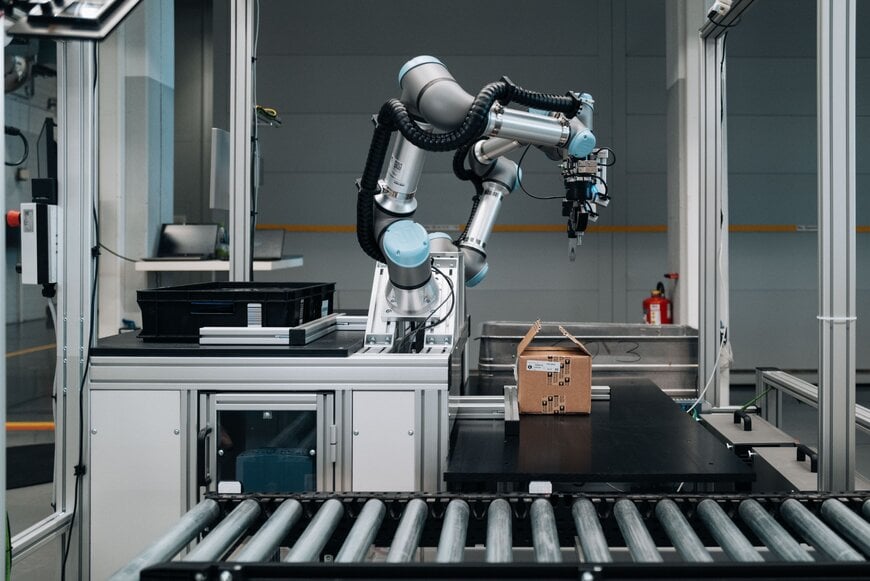
Siemens presented new additions to its automation portfolio at SPS 2026, the international trade fair for industrial automation held in Nuremberg from 24 to 26 November 2026 (Hall 11). The company is integrating Industrial AI across all phases of production, from planning and engineering supported by AI agents to physical AI applied directly in manufacturing processes. At the centre is a goal-oriented automation concept, in which manufacturers define the results they want to achieve and Industrial AI determines how to reach them or carries out the necessary tasks directly through AI agents.
“The next frontier of productivity lies in automating tasks that until now could not be automated,” said Rainer Brehm, President of Automation at Siemens. “That is why we are accelerating the path to AI-based autonomous production, strengthening our established automation portfolio with agentic AI and physical AI technologies. As Industrial AI spreads further into production, cybersecurity is also becoming increasingly central. With almost 40 years of experience in industrial cybersecurity, we continue to ensure our commitment to customers on cybersecurity and regulatory compliance.”
Physical AI for Autonomous Unpacking of Incoming Goods
In electronics production, the high variability in the types and sizes of incoming goods packaging makes it difficult to automate unpacking with predefined robot programs, so these tasks are still largely carried out by hand. At its electronics plant in Erlangen, Germany, Siemens is developing an AI-based solution that uses cameras to capture information about the surroundings in real time. Using AI-based foundation models for robotics, the system interprets the operating context and autonomously determines the actions required: the robot opens the packaging and removes the component reels for the subsequent processing steps.
Siemens contributes its automation technologies, control systems, industrial PCs, orchestration software and application expertise from its own production plants. Standardised device data and cybersecurity are the basic prerequisites for implementing these technologies.
AI Agents Create and Optimise Production Schedules
For production planning, Siemens introduced Autonomous Production Planner, a new solution integrated into Intelligence Center X, its software platform for orchestrating Industrial AI. Several AI agents work together to create production schedules and optimise them automatically based on predefined key performance indicators. Before being implemented in production, each schedule is validated through a physics-based digital twin. Siemens estimates that the solution can reduce manual planning effort by 70% and cut costs by up to 20%.
Eigen Engineering Agent Extended to the Process Industry
Eigen Engineering Agent, which is AI-based and integrated with the TIA Portal engineering software, is expanding its functions to support engineers in adapting automation code. The agent can verify code through simulation, and planned new functions include the generation of functional safety configurations. Through integration with SIMATIC PCS 7, the Siemens distributed control system, the agent is also available for the process industry: it analyses existing control logic, verifies or generates continuous function charts and automatically creates control modules from engineering data, allowing companies to accelerate engineering and reuse their know-how across projects.
With TIA Portal V21.1, customers can purchase individual functions instead of new software versions, without time-consuming project upgrades within the V21 line. New features include multicore support in PLC programs for SIMATIC S7-1500 and an extension of SIMATIC Source Documents, which now also include the hardware configuration and can be processed by AI systems. With SIMATIC AX Motion Control Engineering, engineers can handle automation projects including motion control within a single text-based development environment, with PLCopen support and direct Git integration, as a step towards software-defined automation.
Closed-Loop AI in Production Operations
During production, Industrial AI Suite integrates AI directly into automation systems. AI models running on Industrial Edge can be connected to SIMATIC S7 controllers via PROFINET, enabling real-time AI inference in machine automation processes and new applications such as AI-based motion control. Production data can also be used to retrain, validate and redeploy AI models locally, creating a closed loop covering the deployment, operation and continuous improvement of AI models.
New Controllers, SINAMICS Drives and DC Switching Technology
The SIMATIC S7-1200 G2 basic controller increases motion control functionality and performance, handling up to 32 axes, while the advanced SIMATIC S7-1500 controller offers higher system performance and extended connectivity. Siemens is expanding the new generation of SINAMICS G frequency converters with four new drives based on a common, scalable platform with standardised device data and a Security by Design approach.
The new SINAMICS E210 converter and SIMOTICS E-1EE1 servomotors form an integrated 24V and 48V drive system designed for battery-powered applications such as autonomous mobile robots, with coordinated hardware and software design simplifying integration. With SIRIUS 3QC1, Siemens also presented the world’s first semiconductor contactor for heavy-duty DC applications, according to the company, designed for voltages up to 1,500V and currents up to 600A.
Asset Administration Shell Data for More Than 120,000 Products
Machine-readable, standardised device data is a key element for AI-supported and increasingly agent-based workflows. Siemens is making standardised data according to the Asset Administration Shell (AAS) model available for more than 120,000 hardware products, so that software tools can access and process product information directly, supporting continuous digital engineering and digital twin workflows.
Cybersecurity and Cyber Resilience Act Readiness
Using AI in production requires secure industrial plants. Drawing on almost 40 years of experience in industrial cybersecurity, Siemens follows an approach covering the entire production lifecycle, from design and engineering to operations and services, and also uses AI to strengthen cybersecurity. Siemens is progressively preparing the products in its industrial portfolio affected by the EU Cyber Resilience Act to meet the applicable requirements, supporting machine builders in adapting their solutions to the regulation, whose provisions will apply from 11 December 2027.
Additional Context
This section details technical specifications and competitive benchmarking not included in the original news release.
Siemens’ integration of generative and agentic AI into PLC engineering directly parallels initiatives from major industrial automation peers, including Rockwell Automation’s FactoryTalk Design Studio with Copilot, Beckhoff’s TwinCAT Chat, and Schneider Electric’s EcoStruxure Automation Expert. Where these platforms largely focus on code generation and IT-style version control (such as Git integration), linking Industrial Edge AI inference directly to deterministic PLC cycles over PROFINET addresses real-time closed-loop control requirements that cloud-hosted analytics cannot meet due to network latency.
On the hardware and data-standardization fronts, publishing AAS models for over 120,000 components aligns with Industrial Digital Twin Association (IDTA) specifications, establishing a scale benchmark for vendor-neutral interoperability in multi-supplier plants. Similarly, the 1,500 V / 600 A solid-state DC contactor addresses a growing technical bottleneck in industrial DC microgrids, battery energy storage systems, and high-power charging infrastructure, where semiconductor switching eliminates the mechanical contact wear and DC arc-quenching limitations inherent to conventional electromechanical contactors.
Edited by Aishwarya Mambet, Induportals Editor, with AI assistance.
www.siemens.com
