
www.ptreview.co.uk
18
'26
Written on Modified on
Digital Access Control for Industrial Connectors
igus introduces RFID-based authentication to secure modular cable interfaces and track physical access events.
www.igus.eu
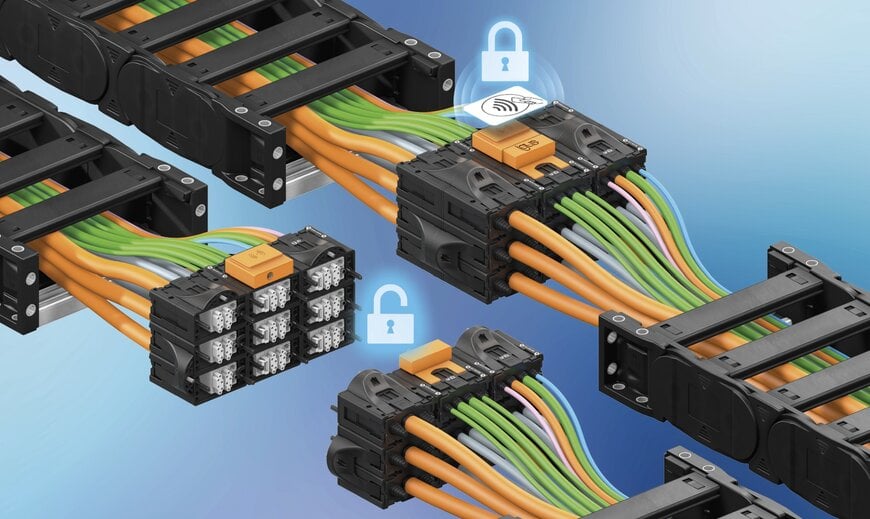
igus is releasing a specialized radio-frequency identification locking mechanism designed to secure high-density power and data interfaces in heavy industrial environments. This digital supply chain component prevents unauthorized disconnections of modular cable systems, mitigating operational downtime and protecting sensitive transmission lines in automated manufacturing and robotic applications.
Integration and Hardware Locking Mechanisms
In complex manufacturing facilities, unverified tampering with power supply connections during critical operations frequently causes extended downtime and necessitates costly service interventions. To address these vulnerabilities, the radio-frequency identification lock operates as a retrofittable hardware addition that snaps directly into existing multi-cable interface housings without requiring specialized installation tools. The hardware utilizes an integrated microcomputer to process authorization requests from authenticated personnel cards. Upon successful verification, the system retracts a mechanical metal pin to grant physical access to the connection points. By digitizing physical access to sensitive power supply and data nodes, the system contributes to a secure industrial data ecosystem capable of logging individual access events. This data retention capability provides maintenance engineers with verifiable transparency for servicing schedules, incident documentation, and quality control operations.
High-Density Interface Consolidation
The underlying hardware architecture allows technical personnel to group 16 or more distinct transmission lines—encompassing electrical power, data buses, fiber optics, and pneumatic hoses—into a single modular interface. By consolidating discrete connectors into a unified module capable of holding up to four interchangeable inserts, the system eliminates multiple individual connection steps. Technical evaluations indicate this consolidation reduces overall assembly time by up to 80 percent. Furthermore, physically combining these connections within a single housing mitigates the risk of polarization or inversion errors during rapid maintenance cycles. The high-density enclosure ensures that these multi-format interfaces can be deployed in machinery configurations where spatial constraints limit the viability of standard industrial terminal blocks.
Additional Context
This section details technical specifications and competitive benchmarking not included in the original news release.
Within the industrial connector market, manufacturers typically secure high-density modular interfaces utilizing mechanical enclosures, padlock brackets, or secondary mechanical latches. Competing systems, such as the Harting Han-Modular series, rely on robust mechanical latching mechanisms to ensure structural connection integrity but traditionally lack integrated digital authentication at the individual connector level. Introducing a microcomputer-controlled, radio-frequency identification locking pin directly into the connector housing shifts the standard from strictly mechanical security to integrated digital access control. The primary benchmark for comparison is the transition from physical key management and external lockout-tagout devices to localized digital authorization, allowing automated facilities to control and log physical connector tampering locally rather than relying on manual inspection protocols.
Edited by Aishwarya Mambet, Induportals Editor, with AI assistance.
www.igus.com
